
Investments
Trump, tariffs and turbulence: lessons for smoother investing
A smoother investment experience could help support client confidence through periods of market uncertainty.

id
The past two years have been anything but quiet for investors.
Markets have had to navigate shifting trade policies, tariff announcements, geopolitical events, inflation concerns, and changing expectations for global growth.
Perhaps the most notable example came in April 2025, when new tariffs sparked significant market volatility before a subsequent pause helped fuel a rebound. It was a reminder of just how quickly headlines can move markets and test investor confidence.
For advisers, this may present a familiar challenge.
When markets become unsettled, clients often question whether they should stay invested, while sharp falls can lead to defensive actions in the hope of avoiding further losses.
Yet time and again, history shows that some of the most damaging investment decisions are made during periods of uncertainty.
Looking back, the period surrounding Trump’s return to office provides a useful illustration of why remaining invested matters and how smoothing can help support better investor outcomes.
Markets can be difficult to live through
As investors faced a steady stream of headlines capable of moving markets sharply in either direction, the past two years have been a powerful reminder of just how difficult staying invested can be.
While fluctuations are a normal part of investing, it can make for uncomfortable viewing for investors watching the value of their pensions rise and fall.
The chart below compares the performance of the Standard Life Smoothed Return Pension Fund with the ABI Mixed Investment 40-85% Shares sector over the same period.
Actual performance of the Standard Life Smoothed Return Pension Fund compared to ABI Mixed Investment 40-85% Shares Sector - From 4 November 2024 to 4 November 2026
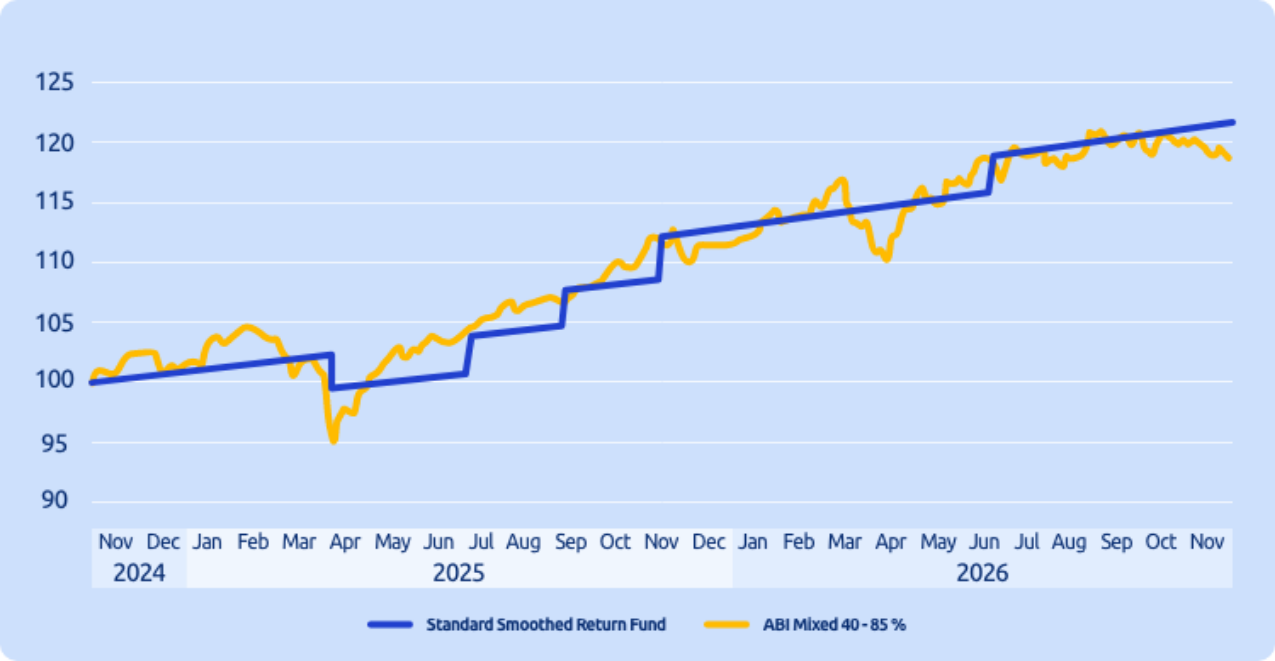
Source: Actual performance data: FE fundinfo Limited, 4 November 2024 to 4 November 2026. Values are net of fund charges. Past performance is not a guide to future performance. The value of an investment can go down as well as up.
It tells an interesting story.
While both participated in broader market growth, the investment journey was noticeably different.
The ABI sector (yellow line) endured several sharp rises and falls as markets responded to events throughout the period. By contrast, the Standard Life Smoothed Return Pension Fund (blue line) followed a more gradual path, reducing the impact of short-term market movements through its smoothing mechanism.
And that's important. Because it's not just about how a journey looks on a chart. It's about how investors feel while they're living through it.
Why volatility matters
Market volatility is typically associated with investment risk. Yet in reality, the bigger risk to investors is how they respond to it.
Behavioural finance research* suggests that investors feel the pain of losses more strongly than the pleasure of gains. As a result, periods of market weakness can trigger emotional responses that lead to poor investment decisions.
When markets fall sharply, investors may be tempted to:
- Move into cash after markets have already fallen
- Reduce investment risk at precisely the wrong time
- Delay reinvesting until uncertainty appears to have passed
- Abandon long-term plans altogether
Unfortunately, these decisions can often lock in losses and reduce the opportunity to benefit from any recovery that follows.
This creates a paradox for investors: staying invested matters most when it feels hardest to do.
What the past two years have shown
The past two years have been a reminder that uncertainty rarely disappears from investing.
Yet the challenge isn't predicting every market movement, it's staying committed to a long-term strategy despite them.
Looking at the chart again, investors had to tolerate periods of noticeable volatility before benefiting from subsequent recoveries. These are exactly the conditions in which investors may be most likely to question their decisions.
This is where smoother returns could make a meaningful difference.
How smoothing can support better investor outcomes
Despite the difference in investment experience shown on the chart, both funds invest in a similar mix of assets, including equities, bonds and cash.
The key distinction is that the Standard Life Smoothed Return Pension Fund incorporates a smoothing mechanism designed to reduce the impact of short-term market fluctuations.
Smoothing isn't intended to eliminate market risk or create returns outside the underlying investments (long-term outcomes are still driven by the performance of the assets in the fund).
Instead, it aims to moderate short-term ups and downs to create a steadier investment experience – which in turn can deliver a valuable behavioural advantage.
By reducing the size and frequency of short-term swings, smoothing may help investors:
- Stay invested during periods of uncertainty
- Avoid emotionally driven decisions
- Maintain confidence in their long-term strategy
- Benefit from market recoveries
Put simply, smoothing can help investors remain focused on their objectives rather than reacting to the latest headline.
The adviser opportunity
Advisers know that investment success isn't just about chasing returns – but about helping clients achieve their long-term goals.
The past two years have provided a useful reminder that how clients get there can matter just as much as where they end up.
A strategy that helps clients stay committed during periods of uncertainty may be just as important as the returns it delivers.
For clients approaching retirement, drawing benefits or naturally less comfortable with the idea of market volatility, a smoother investment experience can help support more productive conversations about remaining invested for the long term.
Looking beyond the headlines
The market events of the past two years have reinforced a lesson that advisers already know well.
We are yet to see the long-term impact of the Midterm results on markets. Political uncertainty will come and go. Markets will continue to respond to changing economic and political developments, and volatility will remain a natural part of investing.
The greatest threat to long-term outcomes is often not the volatility itself, but the decisions investors make because of it.
While the Standard Life Smoothed Return Pension Fund can't remove uncertainty from investing, it can help investors weather the storms and remain focused on their long-term goals
Because when markets become turbulent, staying invested can matter far more than trying to time them.
id
* Source - Oxford Risk report "Beyond risk: Matching solutions to people" (June 2026).
The value of an investment can go down as well as up and your client may get back less than what was paid in. While smoothed funds aim to smooth out some of the daily ups and downs, they don’t provide any guarantees. Past performance is not a guide to future performance.
Related Insights
-

Q3 2026: Market Commentary and Outlook
Anthony O'Brien, Head of Market Strategy, shares his market commentary and outlook for the third quarter of 2026. Anthony O'Brien
October 15, 2026
Read more5 mins read -

Why conviction beats reaction in today's investment markets
In today's investment environment, it's easy to be distracted by headlines, but the best outcomes often come from staying committed to a long-term strategy.
Andy BrownAugust 14, 2026
Read more5 mins read -
Q2 2026: Market Commentary and Outlook
Anthony O'Brien, Head of Market Strategy, shares his market commentary and outlook for the second quarter of 2026.
Anthony O'BrienJuly 22, 2026
Read more5 mins read